India’s Sports Budget 2026-27: Impact of the ₹4,479.88 Cr Influx
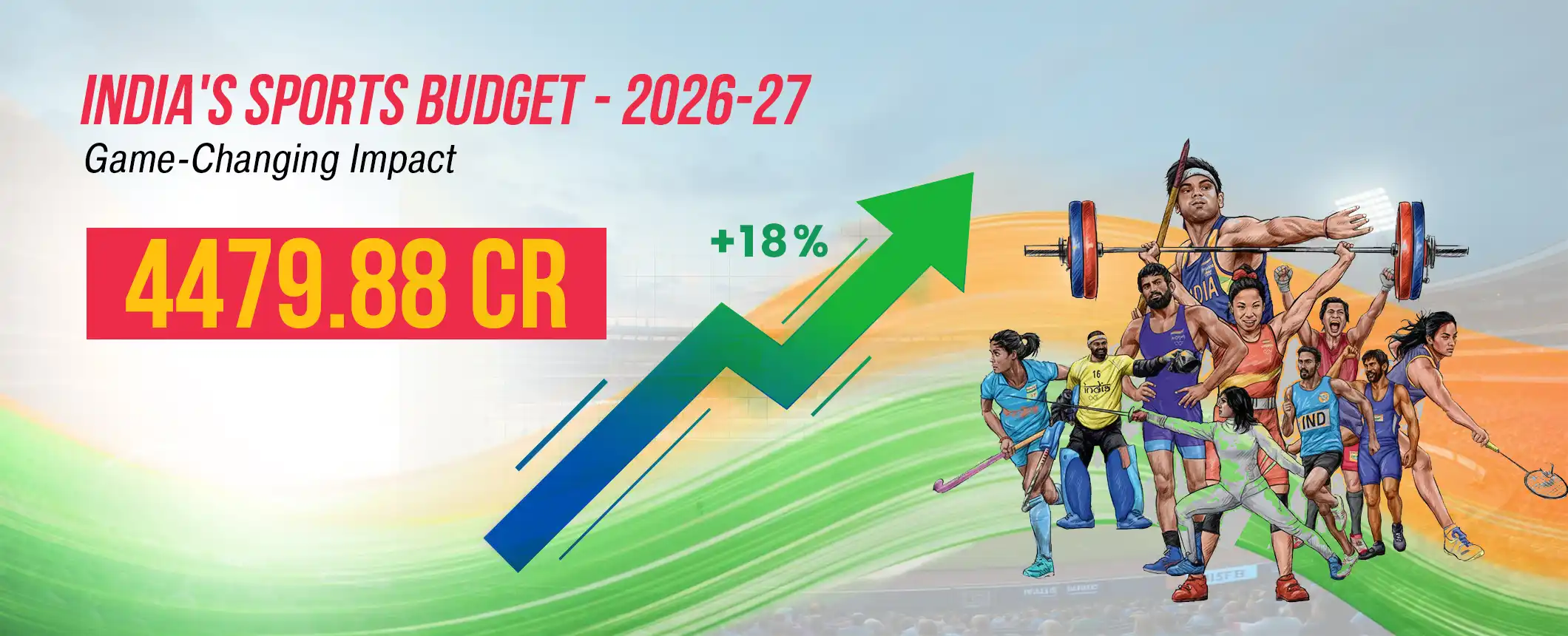
The Union Budget for the FY 2026-27 has arrived and once again India’s sporting ecosystem is getting a massive budgetary boost. With an 18 percent increase, the sports budget of India has seen the highest-ever year-on-year uptick — from ₹3,794.30 crores to ₹4,479.88 crores.
And this isn’t just a customary increase — there’s plenty of allocation changes to newer initiatives as the Ministry of Youth Affairs & Sports has been working proactively to change the sporting landscape in India of late. Even the Hon’ble Finance Minister of India, Ms. Nirmala Sitharaman highlighted how they are increasing the sports budget to leverage upon the growing potential of the sports industry as a major economic growth driver.
Khelo India, which has been a consistent pillar of India’s athlete development pipeline, will be further strengthened via this latest budget. The Sports Authority of India (SAI), who have been tirelessly striving to uplift Indian athletes is also getting going to get better support.
And several other initiatives such as promotion of sports goods & equipment manufacturing along with developing a sports culture among the country’s youth align with what the government has been trying to implement in recent times. The overall gist of this sports budget is checking several boxes with the National Sports Policy (NSP) and the Sports Governance Bill — both introduced last year.
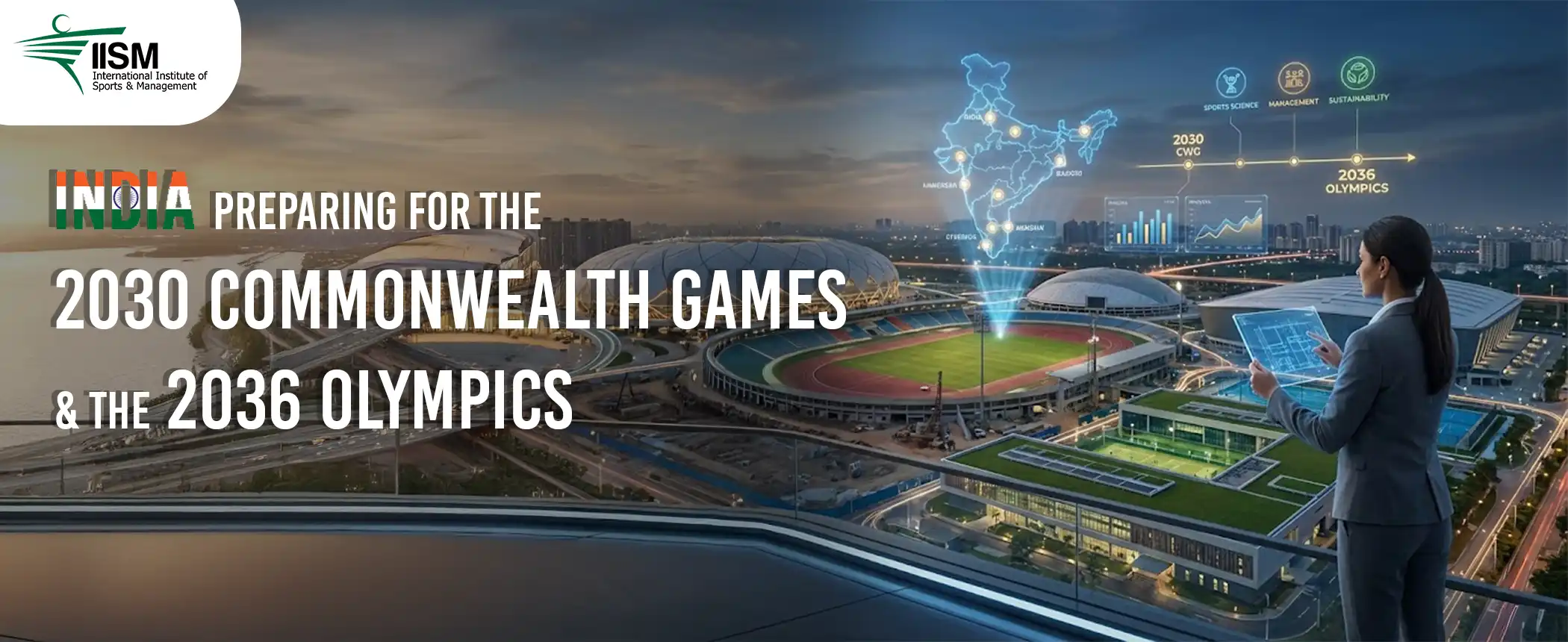
All this budgetary allocation and future plans are to ensure India is ready to host the 2030 Commonwealth Games and the 2036 Olympics, that too, on all fronts. From infrastructure to equipment, training facilities to high-performance centres, India’s sports ecosystem is aiming to match world-class standards. And this budget can be considered as an first round of investment towards those massive profits of fulfilling the Olympic hosting dream.
But how is this going to be implemented on-ground? Let’s decode the major pillars of 2026-27 sports budget and its implications for India’s sports industry, the athletes and relevant stakeholders.
Impact of India’s Latest Sports Budget
Khelo India Mission
Khelo India has been running like clockwork since 2018 and nurturing India’s athletic talent. With five different iterations of competitions at various levels & sporting disciplines, it has also gained some recognition from both players & the fans. However, this sports budget expects more from Khelo India and has repurposed it as a ‘National Mission’ and not just a scheme or programme.
The Hon’ble Finance Minister of India highlighted how they are envisioning the Khelo India Mission to be a keystone feature of a 10-year long strategy to transform India’s sports sector. With Khelo India training centres to be established at the foundational, intermediate & elite levels, they are aiming to do a complete vertical integration of an athlete’s development cycle.
“The Sports Sector provides multiple means of employment, skilling and job opportunities. Taking forward the systematic nurturing of sports talent which is set in motion through the Khelo India programme, I propose to launch a Khelo India Mission to transform the Sports sector over the next decade.”
— Hon’ble Finance Minister of India, Ms. Nirmala Sitharaman
The New Direction of Khelo India
From equipment to facilities & arenas, high-performance training & tech-support to nutrition and diet — the Sports Ministry is highlighting the importance of these aspects to each relevant stakeholder in the ecosystem.
Sports science and technology is a crucial aspect as India has often been a step behind in terms of matching global athletic standards. Meanwhile, availability of infrastructure and facilities is also something that will be underscored under the Khelo India Mission. So that players won’t have to travel miles away from their home towns to find a synthetic track or an astro turf arena!
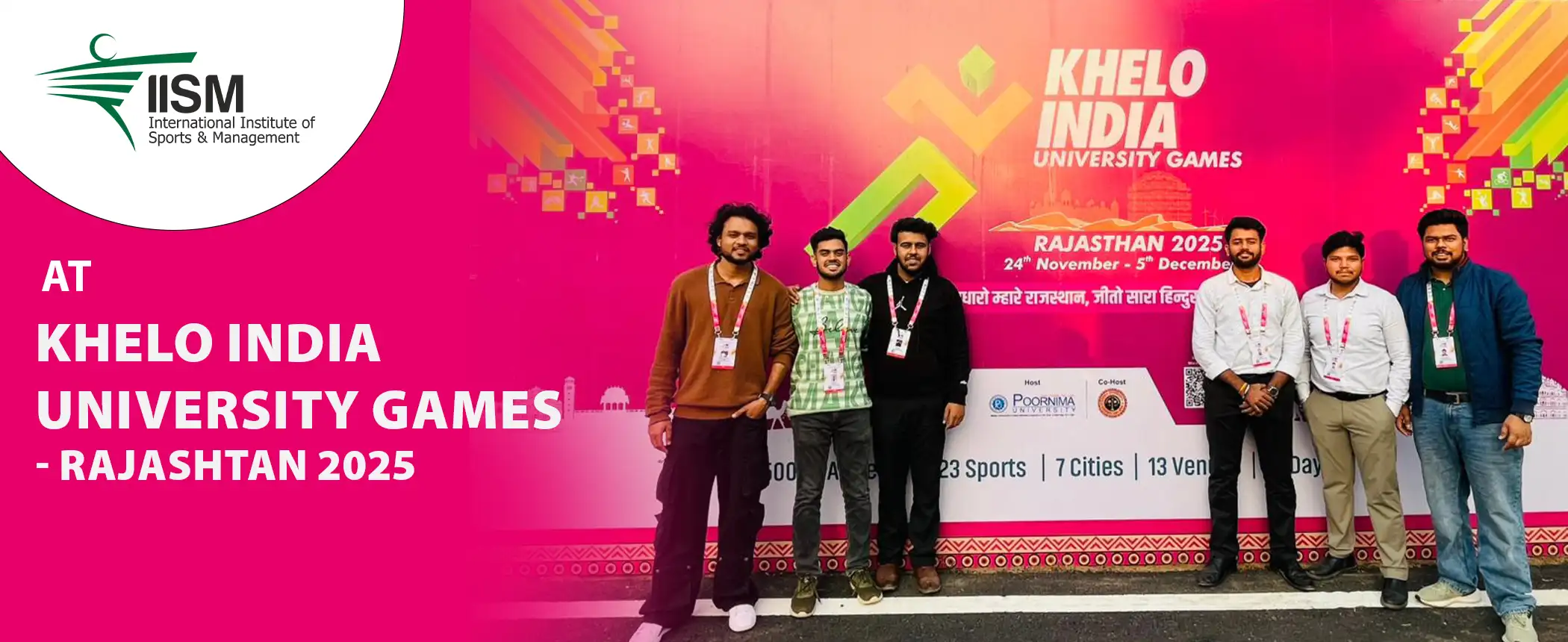
Even the number of Khelo India competitions is going to increase — with 20 different types of competitions coming up, in addition to the existing five verticals namely, Youth Games, University Games, Para Games, Beach Games & Winter Games. The government is wanting to establish competitions, leagues & tournaments at each level to promote a sporting culture among the masses.
And that explains why Khelo India budget has been allotted ₹924.35 crores in the FY26-27. This is a considerable increase from the revised ₹700 crores allocation last year [initial allocation was ₹1,000 crores]. And in the coming years, this budget allocation for Khelo India may keep increasing given how vital it has been to building a solid pipeline of Indian athletes across various sports.
Also Read: IISM’s Role in 5th Khelo India University Games – Rajasthan 2025
Sports Authority of India (SAI): The Backbone
The Sports Authority of India (SAI) has been one of the most important stakeholders of the Indian sports ecosystem. In the past decade, they have amplified their efforts to uplift Indian sports on all front — from facilities to equipment, sports science & technological integration to developing high-performance centres across the country for a plethora of sports.
The National Centres of Excellence (NCOEs) also commonly referred to as Regional Centres (RCs) along with several smaller training centres all fall under SAI’s purview. And these centres have been the epicentre of several Indian talents who are making a name for themselves in the national & international sporting arenas. So, it’s understandable why the allocation for SAI in the sports budget of India has consistently grown in recent years.
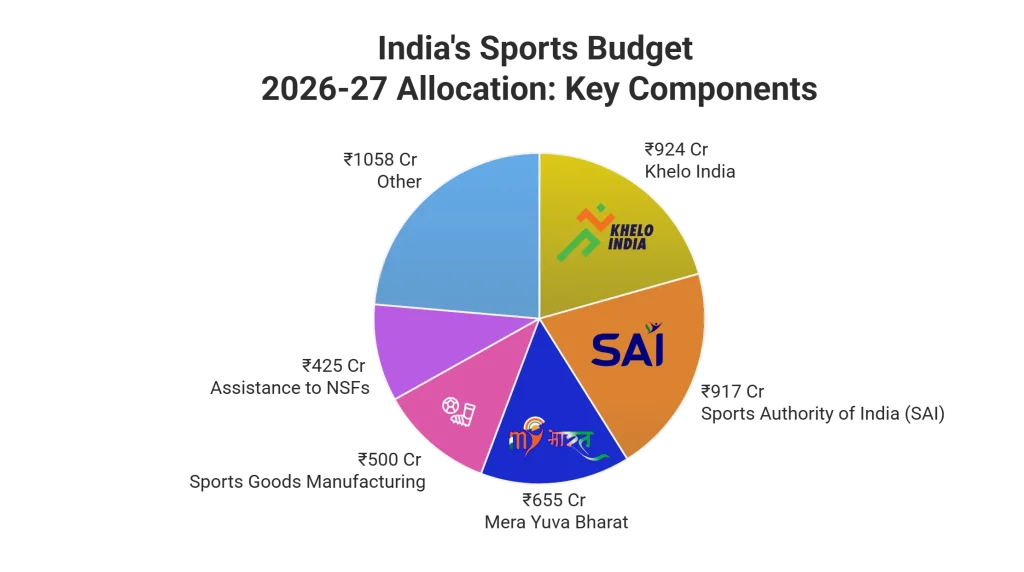
Sports Budget of India 2026-27 Allocation Key Components
From roughly ₹400-410 crores in 2017 to ₹917 crores this year, SAI has seen a steady rise in its funding over the years. And this also maps out with the Sports Ministry’s increasing seriousness towards promoting sports as a mainstream career pathway in the country. To look after athletes, SAI has plenty of job openings for high-performance coaches, physiologists, nutritionists, and several other sports science specialists.
SAI has been spearheading India’s sports science programme and has been hiring and working multiple experts to enhance Indian athletes’ performance per global standards. This increased budget will further bolster SAI’s ability in all these roles & responsibilities.
₹500 Crores for Sports Goods Manufacturing
Sports goods & equipment manufacturing is one vertical of the sports industry that often goes under the radar, even though its roots in India are rather strong. With manufacturing clusters in Jalandhar, Meerut & Ludhiana among other regions, India’s sports good & equipment market has often seen upside potential but been pushed enough to capitalize on the massive market scope.
However, this year’s budget changes the fabric of this sector with a dedicating funding of ₹500 crores only to promote start-ups & existing companies to manufacture, research & design high-quality indigenous sporting goods and equipment. Material science is also something the Hon’ble Finance minister addressed to improve the quality & sustainability of goods & equipment produced in India. By helping Indian manufacturers produce equipment with high-strength composites, carbon fibers, and specialized polymers to ensure better durability & performance on the field.
Once again, matching international standards in terms of sports goods & equipment is important, as athletes in India long for top-notch quality equipment. And relying on imported goods & foreign brands becomes their only option. So, this budgetary allocation to the sports goods & manufacturing sector is a mega boost for athletes in terms of an indirect financial support to them besides the direct sporting assistance.
Sports Science & Technology Integration
Sports Science has been a cornerstone of any nation’s sporting success on the global stage. Inculcating applications of fields like Sports Nutrition, Biomechanics, Strength & Conditioning, Injury Rehabilitation among others is pivotal to enhancing athletic performance. It helps to gain that minute edge of few milliseconds or few centimetres that separates the medalists from the rest of the field.
In India, Sports Science hasn’t been a known field until recently. However, with the Sports Authority of India (SAI) and institutes like National Centre of Sports Science and Research [Funds Allocated: 15 Crores] along with the National Sports University – Manipur [Funds Allocated: ~47 Crores], Indian athletes are seeing the applications of sports science benefit them on the field.
And this budget also reiterated how our athletes need further support via data-driven performance analysis, high-performance training via scientific methodologies and dedicated injury management systems. The BCCI’s Centre of Excellence at the National Cricket Academy (NCA) in Bangalore is doing so quite well. However, this needs to be adopted on a wider scale across various sports. Enhancing athlete longevity, reducing career-threatening injuries are important objectives to focus upon. And the integration of Sports Science in India’s sports ecosystem will be key to this.
Dive deeper into the world of sports science in our blog titled What is Sports Science? — Verticals, Importance & Scope
Mera Yuva Bharat: Skill-Building & Volunteering
The Mere Yuva Bharat (MY Bharat) initiative has been a flagship programme of the government to mobilize the country’s youth into nation-building. Be it via sports or experiential learning in other fields, MY Bharat has been aiming to utilize technology to provide various volunteering opportunities for events and Not-For-Profit organizations.
The core focus of this initiative is to help the youth build essentially skills and make an impact in society. From police assistance work to cyber security, blood donation camps to food distribution — the spectrum of volunteering and experiential learning opportunities is quite wide. And now, the Sports Ministry may further build on this platform to mobilize youth towards sporting events at the grassroots level.
From Khelo India to Khel Mahakumbhs in various regions at the grassroots level, India’s youngsters may get plenty of opportunities via the Sports ministry along with the national sports federations (NSFs) and regional associations. This is going to build a massive workforce, properly skilled via exposure at on-ground events & competitions.
And for the same, this Union Budget 2026-27 is allocating over ₹655 Crores, which is almost 10 times the budget allocation for Mera Yuva Bharat last year. So, this is an elaborate signal by the Finance and Sports Ministry that they are looking to leverage this youth skill-building initiative to further strengthen the sporting ecosystem in India.
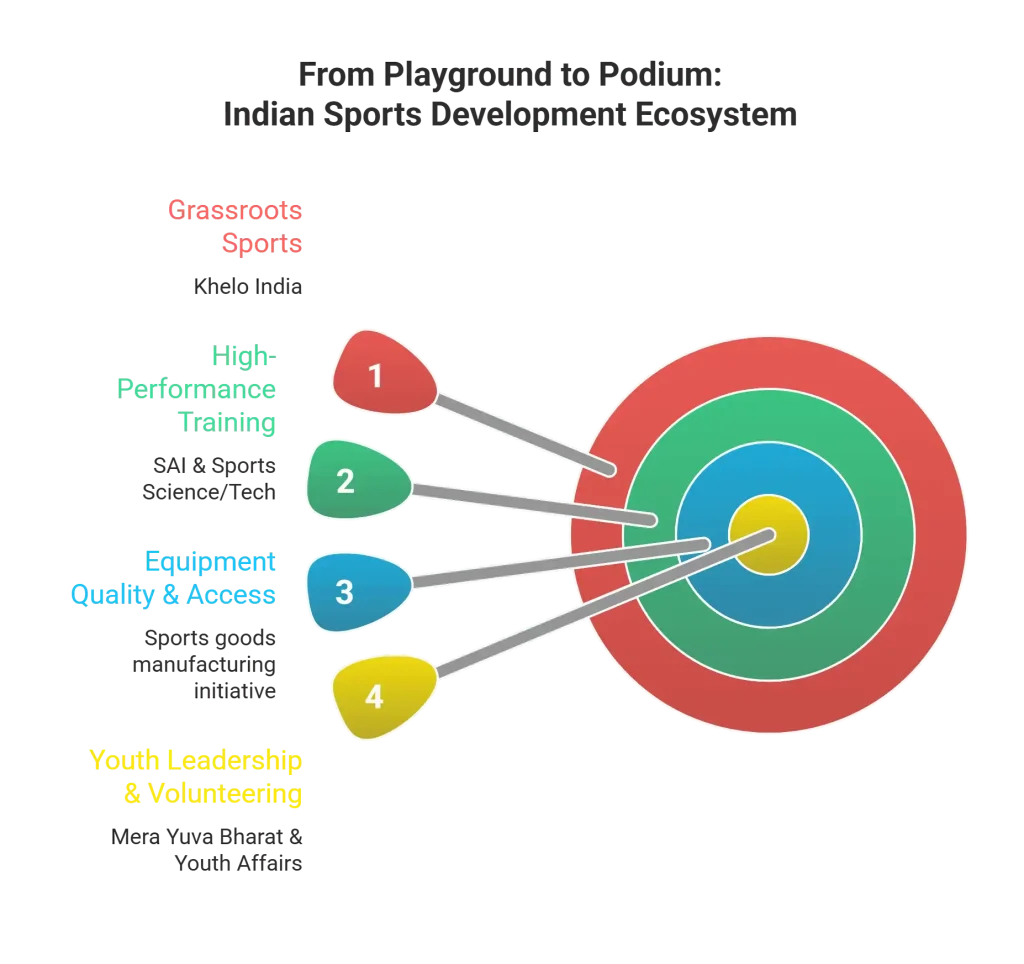
Impact of India’s Key Sports Budget Heads on the Ecosystem
Commonwealth Games, NSFs & National Sports Board
Preparing for CWG 2030 in Ahmedabad
With the 2030 Commonwealth Games confirmed to be hosted in Ahmedabad, all of these above mentioned frameworks, plans & funds are indirectly an investment towards building a global sporting hub in India. The city of Ahmedabad has undergone a major facelift over the past few years, with its civil and sporting infrastructure seeing significant upgrades.
The Sardar Vallabhbhai Patel Sports Enclave and the Veer Savarkar Sports Complex Naranpura are two venues which will most likely be hosting several events of the 2030 Commonwealth Games. From aquatics to 3 x 3 basketball, gymnastics, boxing, and kabaddi will be held at the SVP Sports Enclave. Meanwhile, Naranpura facility will have table tennis, badminton, judo and some of the aquatics events. The Narendra Modi Stadium in Motera will naturally be hosting cricket. But even some of the athletics events are going to held in the Motera stadium along with the opening and closing ceremonies of the Games. For sprinting events, a separate stadium facility is being built in the SVP Sports Enclave.
This is the overview of how the Sports Ministry along with SAI and relevant event & venue stakeholders is preparing Ahmedabad for the 2030 Commonwealth Games. And this year’s budget has allocated around ₹50 Crores for the same. It is expected that in the coming two to three years, this fund allocation will increase significantly as we move closer to 2030 and look to successful host the centenary edition of the Commonwealth Games.
To know more about how India’s preparations for CWG 2030, read our blog titled How is India preparing for the 2030 Commonwealth Games and the 2036 Olympics?
Support to National Sports Federations (NSFs)
National Sports Federations across the country have been assured better support per the latest National Sports Policy and the Sports Governance Bill 2025. With better structure and processes along with a revised eligibility and tenure regulations for the federation heads, the Sports Ministry is strengthening the sports administration in the country.
And as a part of the same plan, the budgetary allocation to all NSFs has been increased from ₹400 Crores from ₹425 Crores in this year’s budget. This funding is also for multiple other functions that the NSFs carry out. From conducting respective national championships to sending teams abroad for high-performance training and for competing in international tournaments — all these need significant financing, which often is seen lacking in several sporting federations.
In fact, the ₹425 crores may also not be enough given the number of national sporting federation for several sporting disciplines. Regardless, the Union budget recognizing this gap and addressing it with a marginal increase is vital and hopefully this allocation goes up furthermore.
Formation of National Sports Board
The Sports Governance Bill 2025 had underlined the requirement of a National Sports Board (NSB) which will oversee the national sporting bodies and ensure accountability on fund usage and other operational aspects. Now, given this is a new board to be formed, the Union budget has allocated fresh funding for the same under the Secretariat Sports line item. Around ₹31.85 Crores will be mobilized towards the formation of the National Sports Board.
Summarizing the Impact of India’s Sports Budget
| Area | Key Impact |
|---|---|
| Talent Pipeline | Deeper grassroots scouting, structured pathways to the top via Khelo India |
| Infrastructure | Upgraded training centres, facilities, venues, and high-performance labs across states |
| Manufacturing Jobs | MSME growth in sports goods & equipment sector, increase in sports gear exports |
| Elite Athletes | Better SAI and NSFs support, technological assistance, stronger global footprint |
| Economy | Sports as an employment driver across verticals, boosting India’s overall growth |
Conclusion
This sports budget for the FY 2026-27 may not be an exact blueprint upon which India’s sports industry will transform in the next decade. But it is surely a major investment — perhaps the first round of many towards building India as a sporting powerhouse on the global stage. And it’s also in alignment with the National Sports Policy and the Sports Governance Bill of 2025, which also aim for the same.
From pushing sectors like sports goods manufacturing to upgrading the country’s sporting infrastructure for the Commonwealth Games and the Olympics — it cover all major bases. ₹500 crores for the sports good sector, consistent uptick in the funding to the Sports Authority of India and Khelo India shows that the Sports Ministry understands the currents gaps in India’s sports ecosystem and is willing to plug those and improve the system overall.
The impact of this 2026-27 sports budget of ₹4479.88 crores that has seen the highest-ever increase of 18 percent Y-o-Y will only be materialized when the relevant initiatives and plans are implemented. And the onus of this execution lies on all key stakeholders such as SAI, the NSFs, the new National Sports Board, the Sports Science institutes, and the Sports Ministry. The bottom line is: if all things fall in place appropriately, India could truly become a sporting powerhouse by the year 2047.
Also Read: Inside India’s Sports Industry: Key Players & Job Scope